



If you spent the last decade winning contracts by sharpening your pencil on price, June 2026 hit hard. The Asian Development Bank rewrote the terms of engagement for every major publicly funded project in the region. The changes are flowing through active tender pipelines now. Suppliers who haven’t adjusted are getting cut before evaluators even open the financials.
Here’s what the market looked like this month — and what to get ready for in July.
The ADB Overhaul: What It Means on the Ground
The ADB’s Technical Assistance Project 59384-001 introduced two requirements that change how contractors price and staff bids. Under the new Merit Point Criteria, technical evaluation carries a minimum weight of 50 to 60 percent on high-value contracts. Price no longer opens the door. Evaluators reject bids that lack localized engineering depth before they even look at the numbers.
The second requirement is tougher to absorb: a mandatory 50 percent local labor quota. Local workers must complete at least half of all person-days on internationally advertised construction contracts. That rule covers every skill level — not just unskilled labor. In Indonesia, Vietnam, and the Philippines, tunnel-boring operators and rail-signaling technicians are scarce. You can’t solve that gap the week before submission.
| “Firms can no longer dump prices to lock out local players. The ADB now demands total lifecycle value — and if you can’t prove it with data, you lose before money is even discussed.” — Regional procurement strategist, Singapore |
Contractors across the region are rushing to form joint ventures with Tier-2 and Tier-3 domestic builders. Winning bids now budget for on-site accredited training centers. That’s a real cost. Put it in your numbers now.
Where the Tenders Are This Month
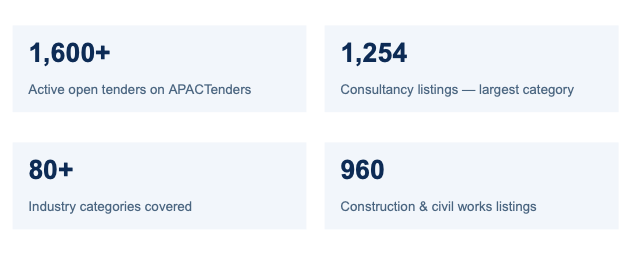
APACTenders lists over 1,600 open opportunities across more than 80 industry categories. Volume clusters in four areas.
Construction & Civil Works — 960 listings
India, the Philippines, and Vietnam drive most of the volume — transport infrastructure, public housing, and port expansion. New Zealand councils are also moving. Whangarei District Council posted a pavement rehabilitation tender on Pipiwai Road Central, closing July 15. Invercargill City Council seeks bids for a duplicate pumping station at Branxholme Water Treatment Plant, closing July 14. Both are mid-tier contracts. Both signal councils spending independently of central government.
Information Technology — 695 listings
The mix has shifted. Agencies are no longer buying cloud storage and hardware. They are buying cybersecurity infrastructure, data governance systems, and automated threat monitoring. They want certifications and hard deployment timelines — not pitch decks. Auckland Transport posted a Passenger Information Display proposal, closing July 13. It asks for hardware, content, and full device management in a single managed-service contract.
Consultancy Services — 1,254 listings (largest category)
Pacific island governments depend on external consultants for planning and feasibility work. The ADB’s new Early Market Engagement requirement adds to that. EME rounds are generating pre-tender consultancy demand ahead of the Q3 mega-project pipeline.
Energy & Renewables — 225 listings
Solar grid integration, high-voltage transmission, and EV charging networks are active across Australia, India, and Malaysia. Evaluators now reject vague sustainability language. They expect carbon tracking data that is site-specific. Even standard supply chain tenders carry that requirement in this category.
Pacific Islands: Smaller Tenders, Real Opportunity
The Pacific islands run their own procurement cycle. Port Moresby’s National Capital District Commission accepted Community Action Grant applications through June 30. Grants ran up to K10,000 and targeted local MSMEs, youth associations, women’s groups, and NGOs. Papua New Guinea’s National Procurement Commission ran a vehicle tender in early June at Government House in Konedobu.
Solomon Telekom posted a used vehicle and generator tender on June 24. Bids close July 10. The window is short but real.
These smaller tenders matter. They keep local supplier pipelines moving. For many firms, they are the first contract that builds the track record needed to bid on bigger work.
The Green Mandate: Evaluators Are Now Enforcing It
In Australia, Singapore, and parts of Malaysia, ESG scoring is now a mandatory evaluation criterion — not an optional add-on. Renewable energy grid integrations and waste-to-energy feasibility studies hit the market this month. Standard supply chain tenders are following the same path. Vendors must document carbon footprint and sourcing practices in the base submission.
Procurement teams spent years writing sustainability language nobody checked. That era is over. Evaluators are checking. Miss the documentation threshold and you are out before the financial review starts.
| Miss the sustainability documentation threshold and you are out before the financial review starts. |
What to Watch in July
Three things matter as the Q3 pipeline opens.
1. Get into EME sessions now. The ADB requires borrowers to run industry roadshows before publishing formal RFTs. Contractors who attend negotiate risk allocation and help write specifications. Those who skip them are already behind when the tender drops.
2. Watch the mega-project transitions. The JB–Singapore RTS Link sits at 90 percent completion. Malaysia’s East Coast Rail Link is at 93 percent. Both projects have moved past heavy civil works. Procurement is now for track systems, station fit-out, and terminal operations — specialisms that were out of scope during the construction phase.
3. Flag the utility tender. Thames-Coromandel District Council in New Zealand has a Registration of Interest open for district-wide universal metering, closing July 10. District metering rollouts typically generate follow-on service and maintenance contracts worth chasing.
Deal flow is not slowing down. But the evaluation criteria have shifted. Review your local labor plan, firm up your sustainability documentation, and get into the EME rooms before the formal tenders land.