


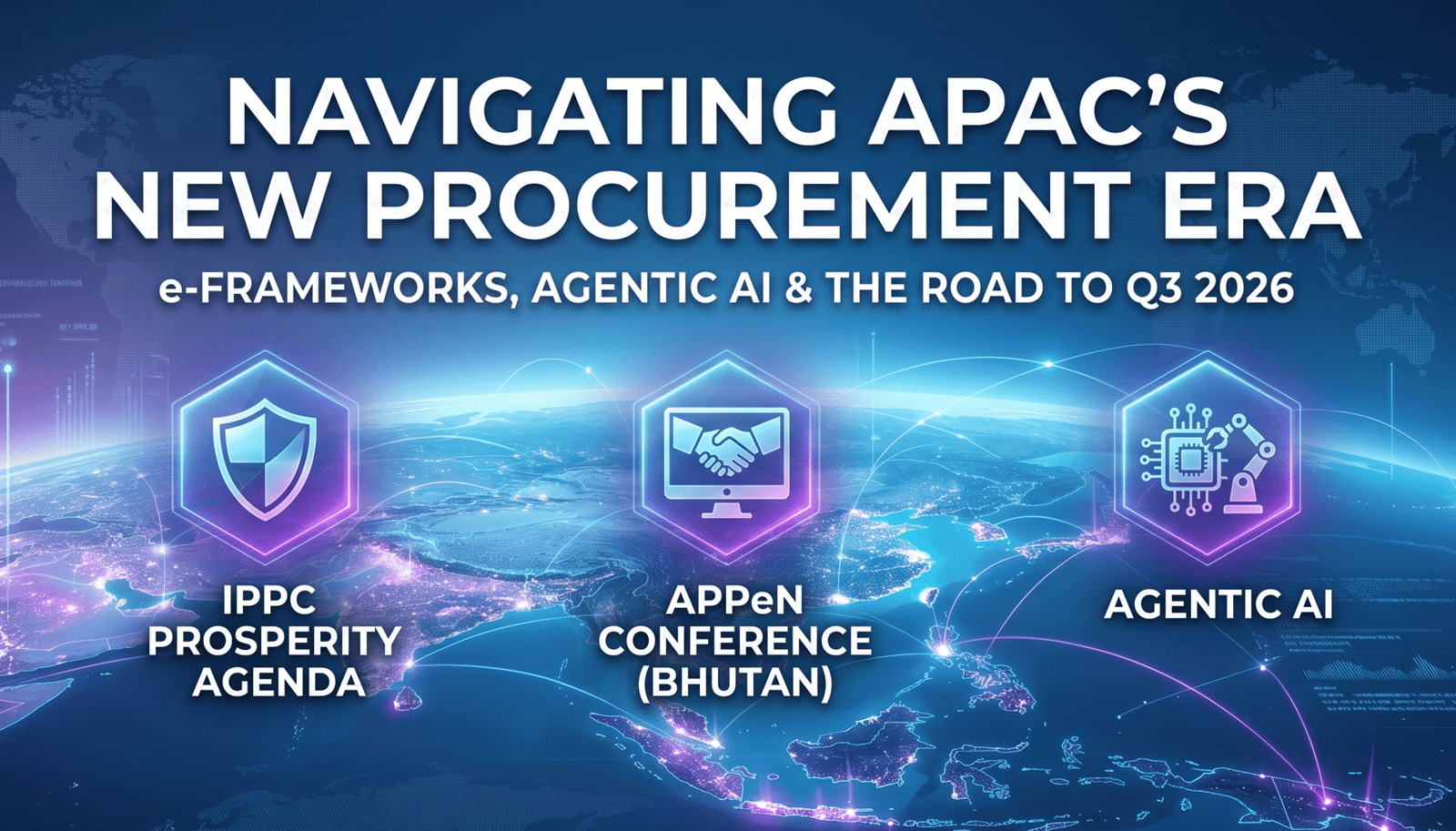
According to mid-2026 updates published by the World Bank, the Asian Development Bank (ADB), and prominent enterprise solution networks, procurement is moving rapidly from traditional cost-containment to technology-driven orchestration. Two major milestones—the institutional rollout of the IPPC 2026 Prosperity Procurement Agenda and the upcoming ProcureCon Asia 2026—are dominating current industry coverage.
In recent institutional briefs, multilateral development partners emphasized that public procurement is no longer just an administrative function but a strategic lever for economic resilience. Following high-level discussions at the International Public Procurement Conference (IPPC) 2026 held in Bangkok, regional focus has locked onto two priorities: digital transformation and micro, small, and medium enterprise (MSME) inclusion.
Under the newly advanced IPPC 2026 Prosperity Procurement Agenda, regional frameworks are moving away from treating procurement primarily as a rigid control mechanism. Instead, they are reshaping it into a tool that expands economic participation, shifting standard policy metrics from traditional “lowest-price criteria” to holistic Value for Money (VfM) frameworks.
Furthermore, official channels have confirmed that the ADB will convene the 11th APPeN Conference on October 5–6, 2026, in Thimphu, Bhutan, to solidify these cross-border tech strategies.
Key institutional initiatives heading into the later half of 2026 include:
While public sectors focus on structural governance, private enterprise channels highlight a sharp divergence between legacy systems and the fast-moving APAC market.
Industry analysis from mid-2026 executive briefs indicates that Southeast Asia and India are rapidly bypassing legacy procurement systems entirely. Instead of bolting AI features onto decades-old software architecture, mid-market organizations in the region are building AI-first infrastructure from the ground up.
    Traditional Automation                 Agentic Sourcing (Q3 2026+)
[Flags data & sends alerts]  --->  [Independently executes task / Identifies vendor]
“Procurement workloads are rising roughly 10% through the end of 2026 while operating budgets remain nearly flat, creating an efficiency gap that can only be closed via autonomous productivity gains.” — Industry Benchmark Data.
Industry networks pinpoint three definitive shifts in enterprise tactics:
The consensus across both public and private procurement networks is clear: individual AI tools do not equal organizational readiness. The organizations gaining a competitive edge in Q3 2026 and beyond are those establishing rigid data standards, upskilling their workforce to co-pilot with autonomous agents, and leveraging localized regional sourcing networks to counter ongoing global trade volatility.