


Compliance Corner
We all know that tendering is not a five minute job. Anyone who has ever tried to navigate a multilateral procurement process, or even a straightforward government tender, knows that compliance is where bids are won, lost, or quietly disqualified before anyone gets to the price envelope.
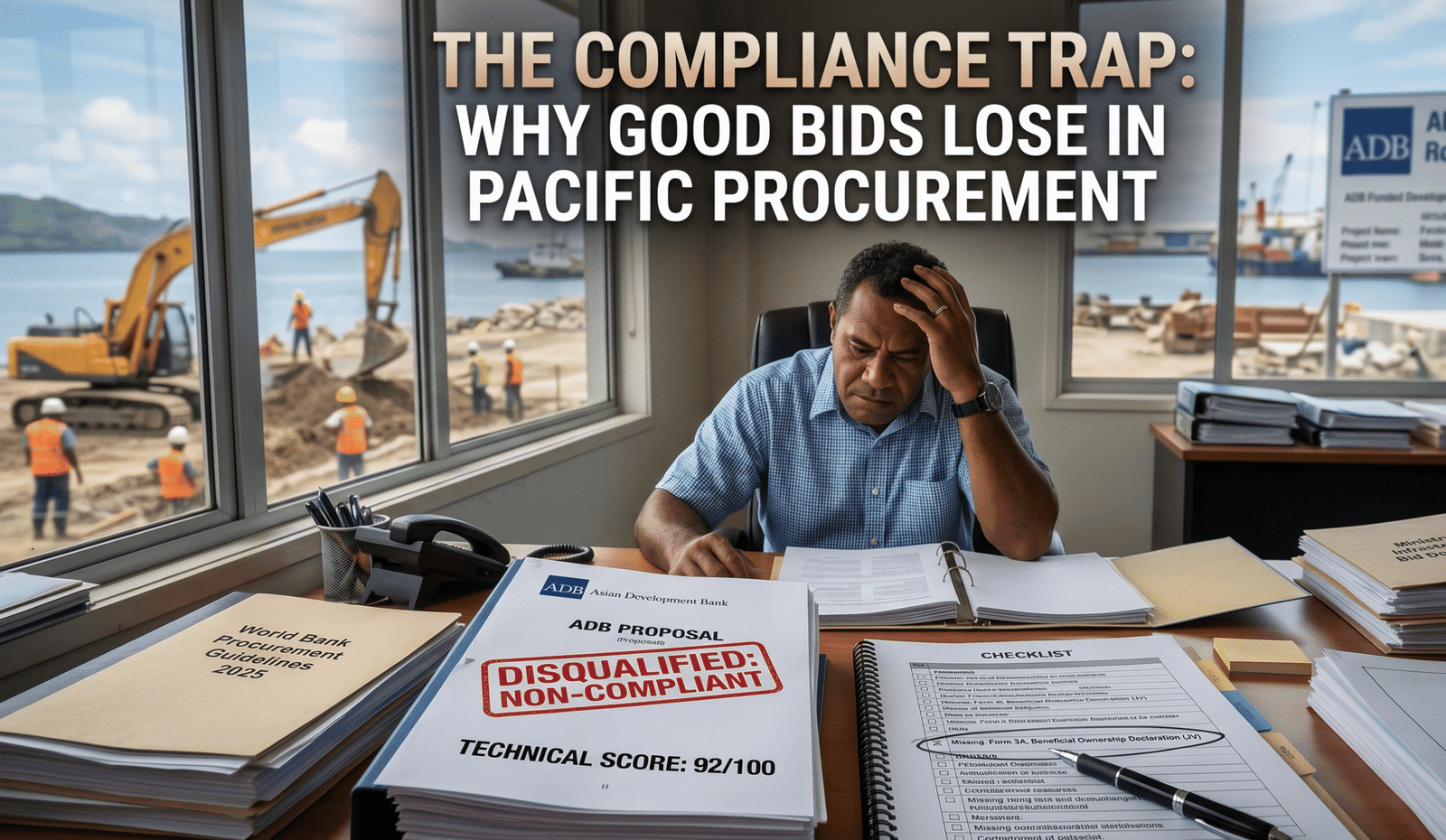
On a humid Tuesday morning at a Ministry of Infrastructure, a project officer flips through a stack of submissions for a road upgrade. The technical proposals look solid: familiar contractors, decent methodologies, reasonable programs. But the real story is beyond the glossy marketing – missing forms, unsigned declarations, inadequate insurance, outdated registrations, and a few creative interpretations of “substantially responsive.” In the Pacific, these are the fish hooks that catch even experienced firms.
What’s New in ADB Procurement?
The 2026 ADB Procurement Directive incrementally resets the rules of the game. It supersedes the 2017 Procurement Regulations, adding sharper governance, clearer accountability and more prescriptive operational steps. Three key shifts:
(1) stronger oversight through mandatory standstill periods and expanded complaint‑handling;
(2) tighter integrity and eligibility controls, including more explicit conflict‑of‑interest and debarment checks; and
(3) a new emphasis on Strategic Procurement Planning, early market analysis and structured ‘merit point’ evaluation criteria
What’s New in ADB Procurement?
The 2026 ADB Procurement Directive incrementally resets the rules of the game. It supersedes the 2017 Procurement Regulations, adding sharper governance, clearer accountability and more prescriptive operational steps. Three key shifts:
(1) stronger oversight through mandatory standstill periods and expanded complaint‑handling;
(2) tighter integrity and eligibility controls, including more explicit conflict‑of‑interest and debarment checks; and
(3) a new emphasis on Strategic Procurement Planning, early market analysis and structured ‘merit point’ evaluation criteria
ADB’s procurement rules (updated in January 2026 – see inset) are designed to be predictable, transparent and defensible. But they are also unforgiving. The January 2026 upgrade to Procurement Regulations for Borrowers, known as the Procurement Directive,
The most common traps for bidders include:
ADB’s philosophy is simple: if the document asks for it, provide it exactly as requested. No assumptions, no “equivalents,” no “we will submit later.” A single omission can render an otherwise strong bid nonresponsive.
World Bank procurement: Flexibility with structure
The World Bank’s Procurement Regulations (2025) provides a more risk and principlesbased approach – value for money, fitforpurpose, proportionality. But the flexibility sometimes misleads bidders into thinking the rules are looser. They are not.
The Bank’s most common compliance pitfalls include:
Where ADB is rigid, the World Bank is procedural. Both expect discipline.
National governments: Local rules, real consequences
National procurement rules are often overshadowed by donor systems, but unless the bid is clear that they don’t apply, they usually do. If a contract is to be signed by the national government, it will need to be approved by the relevant Tender Board. To achieve that, there are a range of precedent steps that must be followed, else you risk a delay, or worse, bid disqualification. The most frequent issues include:
Government systems are built on administrative compliance. Miss a step, and your bid doesn’t proceed.
The Three Big Fish Hooks
Across ADB, World Bank and government processes, three compliance traps consistently trip bidders:
1. Incomplete documentation
Most disqualifications are not technical, they’re clerical. Missing signatures, outdated forms, incorrect JV authorisations, or failure to include mandatory attachments. These are preventable errors.
2. Misunderstanding responsiveness
A “responsive” bid is not one that is technically sound, it is one that meets every requirement of the bidding document. A brilliant methodology cannot compensate for a missing form.
3. Assuming donor systems are interchangeable
ADB and the World Bank share principles but differ in execution. Government rules differ again. Bidders who treat them as the same systems inevitably fall into compliance gaps.
Why Compliance Matters More Now
The Pacific’s infrastructure pipeline is expanding, but so is scrutiny. Cofinancing between ADB and the World Bank means more harmonised checks. Government procurement reforms, like those in the Solomon Islands, are tightening oversight, including through digitisation. And with larger, climateresilient projects on the table, the risk of disputes, and the need for defensible procurement decisions, is rising.
Compliance is no longer an administrative hurdle. It is a competitive advantage.
The Bottom Line
Tendering in the Pacific is not about who can pour concrete the fastest, design the best-value alternative, or mobilise the biggest excavator. It’s about who can read, interpret and execute the procurement requirements with precision. The firms that win consistently are not always the biggest, they are the ones who treat compliance as a critical discipline, not an afterthought.