


TL;DR / Quick Summary:
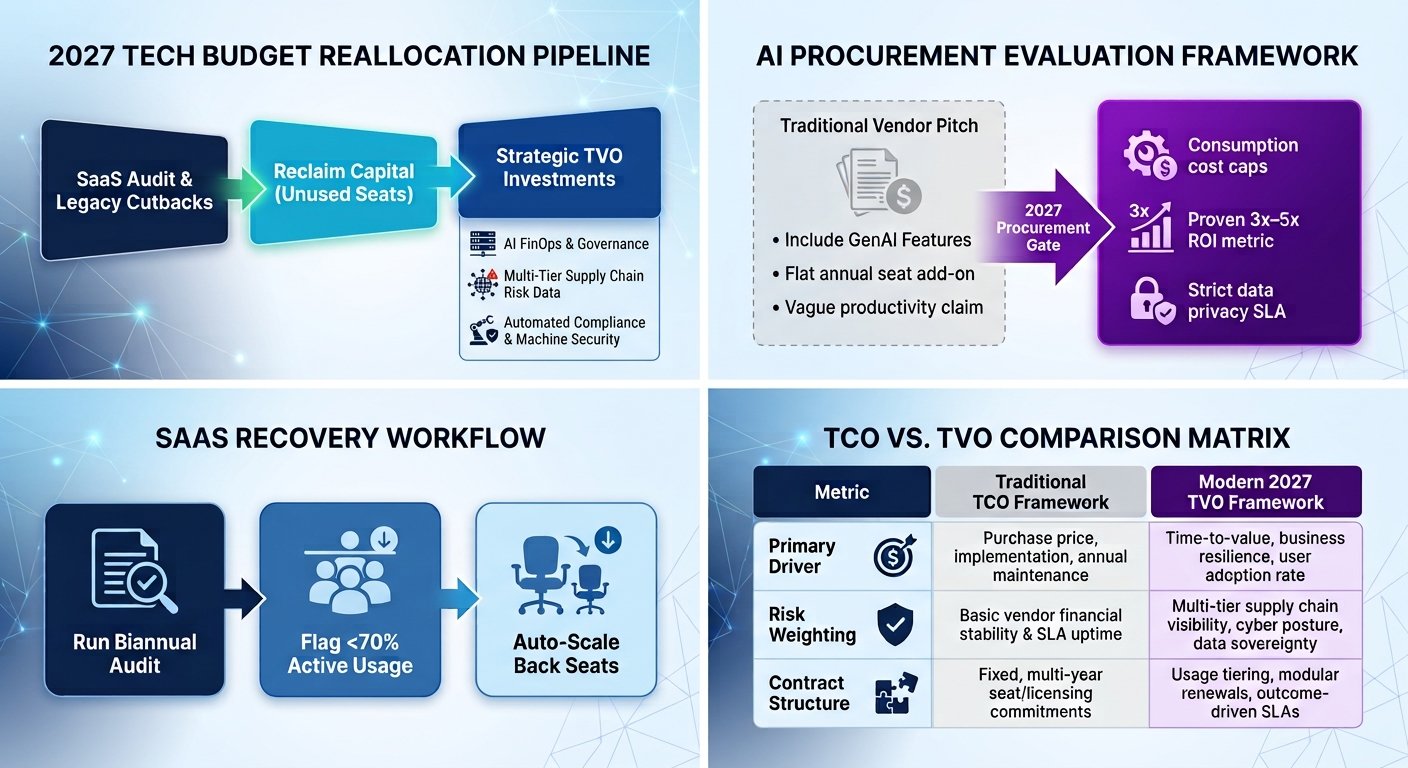
Heading into 2027, enterprise IT spending is projected to grow ~5%, but CPOs and CIOs are abandoning blanket software renewal increases. To maximize budget impact, procurement leaders are prioritizing four strategic shifts: 1) AI FinOps & governance, 2) Total Value of Ownership (TVO) sourcing models, 3) SaaS consolidation to eliminate shadow IT, and 4) Automated regulatory compliance platforms.
Enterprise tech budgeting is shifting from simple cost-cutting to strategic capital reallocation. Rather than signing off on automatic SaaS fee hikes or routine hardware refreshes, chief procurement officers (CPOs) and chief information officers (CIOs) are scrutinizing every line item to balance AI innovation with strict financial and regulatory controls.
Procurement teams are controlling AI costs by moving away from broad generative AI pilots and implementing AI FinOps tools. These platforms tag, monitor, and cap consumption-based API usage across departments.
CPOs are prioritizing Agentic AI—autonomous software agents designed to automate high-volume procurement tasks such as:
Executive Action Item: Require all vendors pitching AI capabilities to sign Service Level Agreements (SLAs) covering output accuracy, data privacy, and usage cost caps before approving proofs of concept (POCs).
Traditional Total Cost of Ownership (TCO) evaluates only upfront purchase prices, maintenance, and licensing. Total Value of Ownership (TVO) expands evaluation criteria to include time-to-value, user adoption, supply chain resilience, and compliance risks.
| Metric | Traditional TCO Framework | Modern 2027 TVO Framework |
|---|---|---|
| Primary Driver | Purchase price, implementation, and annual maintenance | Time-to-value, business resilience, and user adoption rate |
| Risk Weighting | Basic vendor financial stability & SLA uptime | Multi-tier supply chain visibility, cyber posture, and data sovereignty |
| Contract Structure | Fixed, multi-year seat/licensing commitments | Usage tiering, modular renewals, and outcome-driven SLAs |
Executive Action Item: Update RFP scoring rubrics to assign at least 20% of technical evaluation scores to integration ease, time-to-value, and user experience (UX) to prevent shelfware.
Shadow IT and redundant SaaS applications account for 15% to 30% of total enterprise IT spend. Unmonitored auto-renewals and low seat utilization quietly drain technology budgets.
Strict regulatory frameworks—such as the EU Corporate Sustainability Due Diligence Directive (CSDDD), the EU AI Act, and expanding regional data privacy laws—are forcing enterprises to automate compliance and supply chain tracking.
Enterprise IT spending is projected to grow approximately 5%, with capital shifting heavily from legacy software maintenance toward AI infrastructure, automated risk management, and cloud governance.
Generative AI focuses on content generation (text, code, summaries), whereas Agentic AI operates autonomously to execute workflows—such as analyzing market bids, initiating reorders, and verifying supplier credentials without manual intervention.
Procurement teams prevent unexpected costs by implementing AI FinOps tools, enforcing consumption caps in vendor contracts, and requiring usage-tiered pricing structures instead of flat-rate AI seat add-ons.