


Key Takeaways
- AU$1.2M Cable Station: Australian firm DXN will build a modular Cable Landing Station (CLS) in Honiara for the new Adamasia Cable System 1 (ACS-1).
- Google Bulikula Network: ACS-1 links directly to Google’s Bulikula subsea cable system, backed by AU$104M in Australian AIFFP financing.
- Airport Safety Modernization: The World Bank-supported SIRAP2 project is upgrading runways, navigation systems, and lighting at Henderson International Airport and provincial airfields.
- Resilience Focus: Infrastructure upgrades feature off-grid solar storage and climate-hardened structural standards.
The Solomon Islands is executing a major modernization of its digital and transport networks. By upgrading its subsea internet backbones and air transit hubs, the Pacific nation aims to strengthen economic resilience, boost trade, and protect critical links against extreme weather.
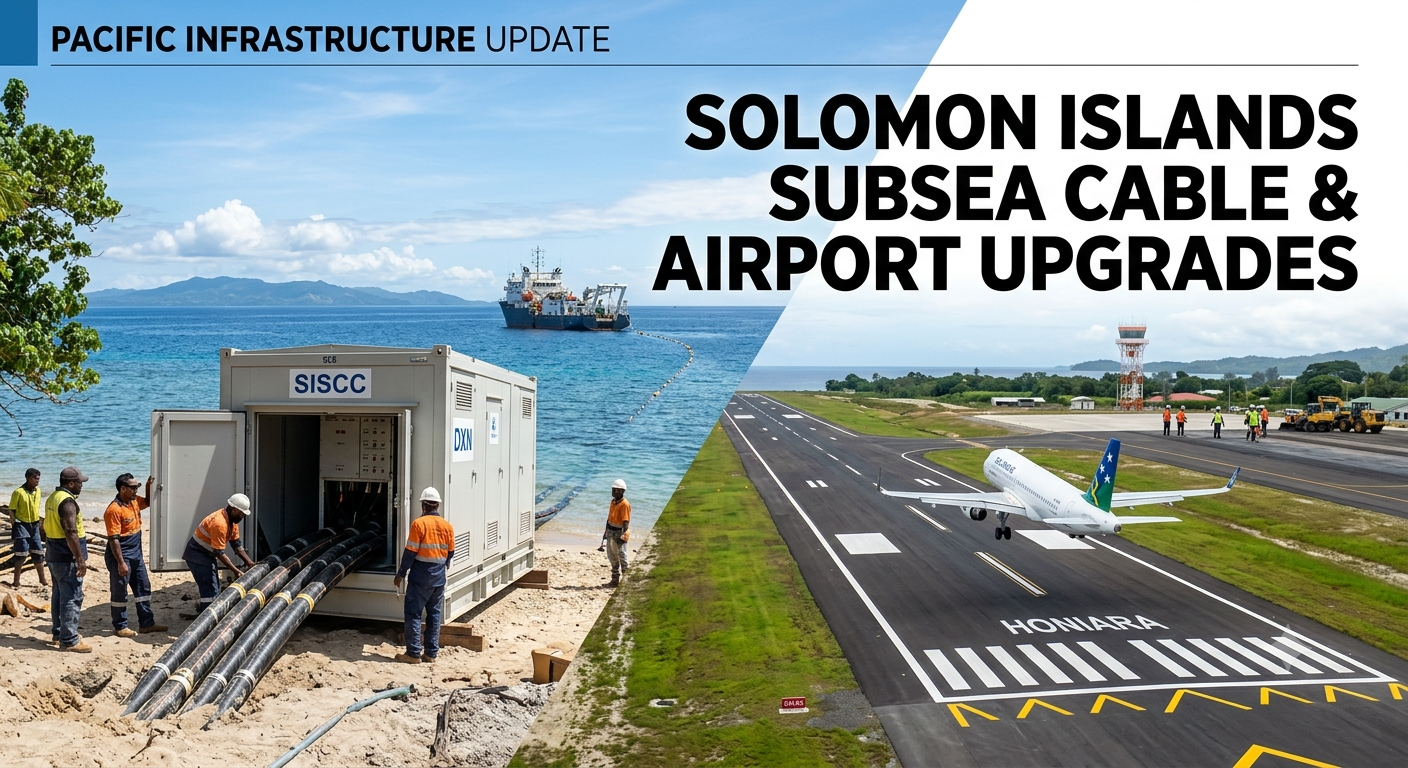
The Solomon Islands Submarine Cable Company (SISCC) has awarded Australian data center specialist DXN an AU1.2million(US840,000) contract. DXN will design, deliver, and install a prefabricated, climate-resilient Cable Landing Station (CLS), slated for completion by April 2027.
The station serves as the terrestrial gateway for the Adamasia Cable System 1 (ACS-1). ACS-1 is a 1,015-kilometer subsea fiber-optic branch connecting Honiara to Google’s regional Bulikula cable system between Guam and Fiji.
The Australian Government is funding the project through the Australian Infrastructure Financing Facility for the Pacific (AIFFP) via an AU$104 million grant and loan package. Key highlights of the agreement include:
ACS-1 marks the country’s second international submarine internet cable, complementing the Coral Sea Cable System (CS²) deployed in 2019.
In parallel with telecommunications upgrades, physical transport links are undergoing comprehensive overhauls through the Second Solomon Islands Roads and Aviation Project (SIRAP2). Supported by the World Bank, SIRAP2 focuses on improving aviation safety and air connectivity across the archipelago.
These aviation enhancements reduce travel costs, maintain air access during natural disasters, and ensure compliance with international aviation standards.
| Infrastructure Project | Primary Partner / Funder | Key Feature | Target Delivery |
|---|---|---|---|
| ACS-1 Cable Station | DXN / SISCC / AIFFP | Prefabricated modular CLS with backup power | April 2027 |
| Bulikula Subsea Cable Link | Google / Australian Govt | 1,015 km branch line connecting to Guam-Fiji trunk | Late 2027 |
| SIRAP2 Aviation Upgrades | World Bank | Airfield lighting, navigation, and runway overhauls | Ongoing |
Looking ahead, these parallel digital and physical infrastructure investments reflect a deliberate effort by the Solomon Islands to future-proof its economy against geographic isolation and growing climate vulnerabilities. By securing direct access to international fiber-optic networks and hardening core transport routes, the nation is establishing the foundation required to support sustainable trade, attract regional investment, and maintain vital lifelines during natural disasters. As construction progresses toward 2027, the success of these projects will likely serve as a key benchmark for infrastructure-driven resilience across the broader Pacific.