


Agriculture is the primary source of income for many farmers in Asia. According to a report from the Asian Development Bank (ADB), 75% of them are reliant on this industry. However, the same report warns that climate change could decrease crop yield by 15% to 20%—and in some cases even by as much as 50%—by 2050. In the Lao PDR, agriculture remains the backbone of its economy. The sector employs around 70% of the workforce and contributes about 16% of the Lao PDR’s GDP in 2024. To strengthen climate resilience, improve food security, and raise rural incomes, ADB has launched a major effort to bolster the agrifood systems shift in Lao PDR.
Additionally, the initiative, called the Sustainable Agrifood Systems Sector Project, seeks to strengthen agrifood systems targeted at both domestic and international markets for high-value commodities.
According to ASEAN Briefing, the agriculture sector in the Lao PDR has its origins in subsistence farming, which is a form of agriculture in which farmers grow crops and raise livestock primarily for their consumption and that of their families, with little to no surplus for sale or trade. In the 2000s, the government helped transform the industry with initiatives lessening shifting cultivation and encouraging market-oriented yields. Recently, the country has been exporting high-value crops to nearby countries like Thailand, Vietnam, and China.
In addition to providing financial services across the country, the $65.8-million initiative will provide infrastructural and technical consulting services in the northern provinces of Houaphan, Phongsali, and Xaignabouli, and the southern provinces of Champasak, Salavan, and Xekong.
Additional assistance will be provided to high-value commodities such as bamboo, coffee, durian, sustainable cassava, and tea in order to boost value addition before export.
ADB Country Director for the Lao PDR Shanny Campbell noted that the initiative reflects ADB’s broader commitment to strengthening long-term food and nutrition security across Asia and the Pacific, as previously announced during the Bank’s 58th Annual Meeting in May. “By strengthening agrifood systems, this project will benefit rural households and enterprises through higher incomes and enhanced access to markets,” she added.
In 2024, ADB published a report called Strengthening Foundations For A Food- And Nutrition-Secure Future In The Lao People’s Democratic Republic. The publication cited the Lao Bureau of Statistics, stating that one in ten individuals in Laos experienced food shortages in 2020. It adds that poor road access, big families, and low levels of education raise the risk of food insecurity.
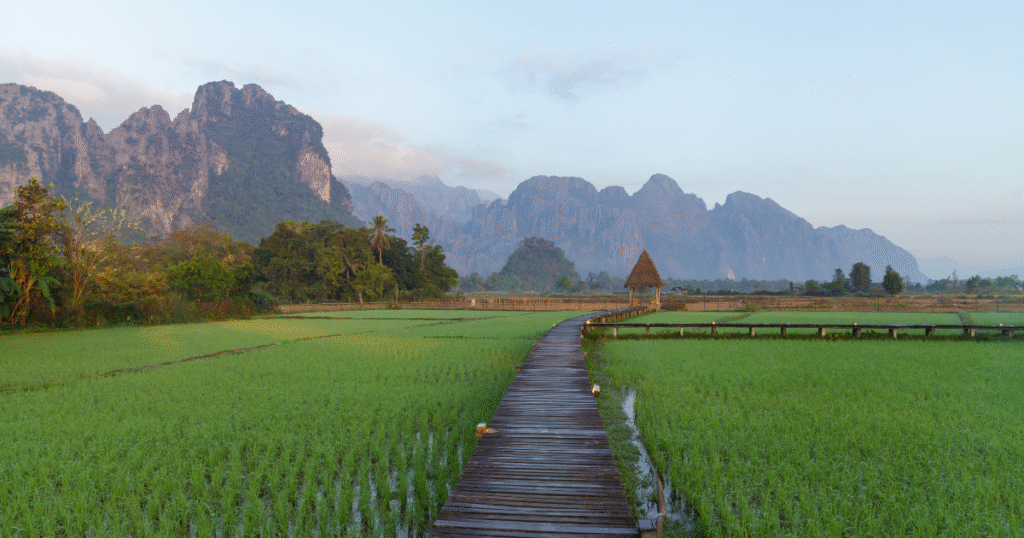
One of the staple foods in a Lao household is rice, which is also the country’s dominant crop. The Lao PDR’s Climate Risk Profile said that while there are studies showing some benefits of climate change towards paddy rice plantations, there is still uncertainty in the future of rice production. The same profile reported that rice is susceptible to high temperatures in the evenings, and with the projected rise in nighttime temperatures in Lao PDR, it could affect rice production from 5% to 20% by the 2040s.
Countries like Lao PDR must transition from reactive to proactive, integrated planning as climate threats increase and constraints on food systems increase. This project connects climate action with equitable economic growth, providing a model for others in the region to follow.
With the momentum behind the agrifood systems shift in Lao PDR, it has the potential to become a regional model for the integration of sustainable procurement and climate-resilient development.