

MANILA / HONIARA — Asia-Pacific procurement accelerated through June 2026. The APACTenders platform recorded over 1,600 active tenders across construction, technology, energy, and professional services. The month’s defining story was the Asian Development Bank’s overhauled procurement framework. It is changing how international contractors write and price their bids on multilateral-funded projects across Southeast Asia.
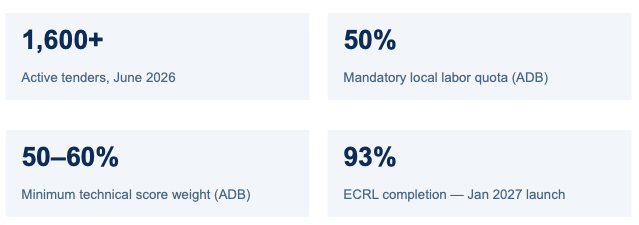
The ADB’s revised framework operates under Technical Assistance Project 59384-001. It sets technical evaluation at a minimum weight of 50 to 60 percent for high-value, high-risk contracts. Under the new Merit Point Criteria, evaluators will not open a financial proposal unless the bid clears the technical threshold first.
The ADB also enforces a 50 percent local labor quota. Local workers must complete at least half of all person-days on internationally advertised construction contracts. The rule applies across all skill levels.
That quota creates real pressure in markets where technical specialists are scarce. In the Philippines, Vietnam, and Indonesia, tunnel-boring operators and advanced rail-signaling technicians are hard to source locally. Contractors in those markets are forming joint ventures with Tier-2 and Tier-3 domestic builders. They are also budgeting for on-site training facilities as a bid cost, not an afterthought.
The ADB now requires a mandatory Early Market Engagement phase for large procurements. Executing government agencies must run structured industry consultations before publishing a formal Request for Tender. Procurement advisers in Singapore and Manila report that EME sessions have become the real competitive front line. Firms that attend co-author technical specifications and risk frameworks — long before the official tender window opens.
Construction and infrastructure led all tender categories this month. Activity concentrated in India, the Philippines, Vietnam, Australia, and New Zealand.
In New Zealand, Whangarei District Council seeks contractors for pavement rehabilitation on Pipiwai Road Central. Bids close July 15. Invercargill City Council seeks a contractor for a duplicate pumping station at Branxholme Water Treatment Plant. Bids close July 14. Both councils are spending independently of central government programs.
Auckland Transport posted an open proposal for Passenger Information Display hardware, content management, and device operating system supply. It closes July 13. The tender reflects the regional shift toward integrated managed-service contracts in public transport networks.
In Papua New Guinea, the National Procurement Commission ran a vehicle tender in early June at Government House in Konedobu. The National Capital District Commission closed its 2026 Community Action Grants program on June 30. It awarded grants of up to K10,000 to local MSMEs, youth groups, and NGOs in Port Moresby.
Solomon Telekom Company Limited published a tender on June 24 for used vehicles and a generator. Bids close July 10. Suppliers can submit by email or in person at the company’s Mud Alley and Ranadi locations in Honiara.
Information technology held the second-largest tender volume, with 695 active listings. The content has shifted significantly. Agencies and public utilities are now buying cybersecurity infrastructure, data governance systems, and automated threat monitoring. Cloud migration and hardware rollouts — which dominated two to three years ago — have dropped down the priority list.
Procurement advisers report that agencies now demand proof of data security certifications and localized support capability. They are also writing service level agreements with explicit uptime thresholds and financial penalties — terms that rarely appeared in earlier government technology contracts.
Energy tenders — 225 active listings — covered solar grid integration, high-voltage transmission upgrades, and EV charging network rollouts across Australia, India, and Malaysia. Evaluators flagged a notable shift this month. Mandatory ESG scoring now appears in standard supply chain tenders outside the energy sector. Vendors must document carbon footprints and sustainable sourcing practices in the base submission. Markets enforcing this include Singapore, Australia, and Malaysia.
The Johor Bahru–Singapore Rapid Transit System Link has passed 90 percent completion. Procurement has moved on from civil works. Buyers are now sourcing internal track systems, station facade work, and terminal transport connectivity at Bukit Chagar.
Malaysia’s East Coast Rail Link — 665 kilometres connecting Kota Bharu to Port Klang — has passed 93 percent completion. The project team is running system integration tests ahead of the January 2027 commercial launch target.
| Both projects have left the civil phase behind. Track fitment, systems integration, and station fit-out contracts are now open — roles that were out of scope during construction. |
Procurement activity will stay elevated in July. Q3 budgets are releasing and the ADB EME calendar is filling fast ahead of a heavy tender pipeline.
Thames-Coromandel District Council has a Registration of Interest open for district-wide universal metering, closing July 10. New Plymouth District Council’s Bell Block Beach Concessionaire proposal closes July 13. It targets operators in coastal tourism and recreation services.
Consultancy services lead all categories at 1,254 active listings. Development bank-funded feasibility and project management work across Pacific island nations and Southeast Asia drives that volume.
Suppliers in construction, water infrastructure, transport technology, and energy should monitor APACTenders for Q3 RFTs. Several will publish following EME sessions now underway.
Data sourced from APACTenders.com active tender listings as of June 28, 2026. Closing dates are as published on the platform and subject to extension or amendment by the issuing authority.
Tender alerts and subscriptions: contact@apactenders.com · Solomon Islands: +677 38229 ·