

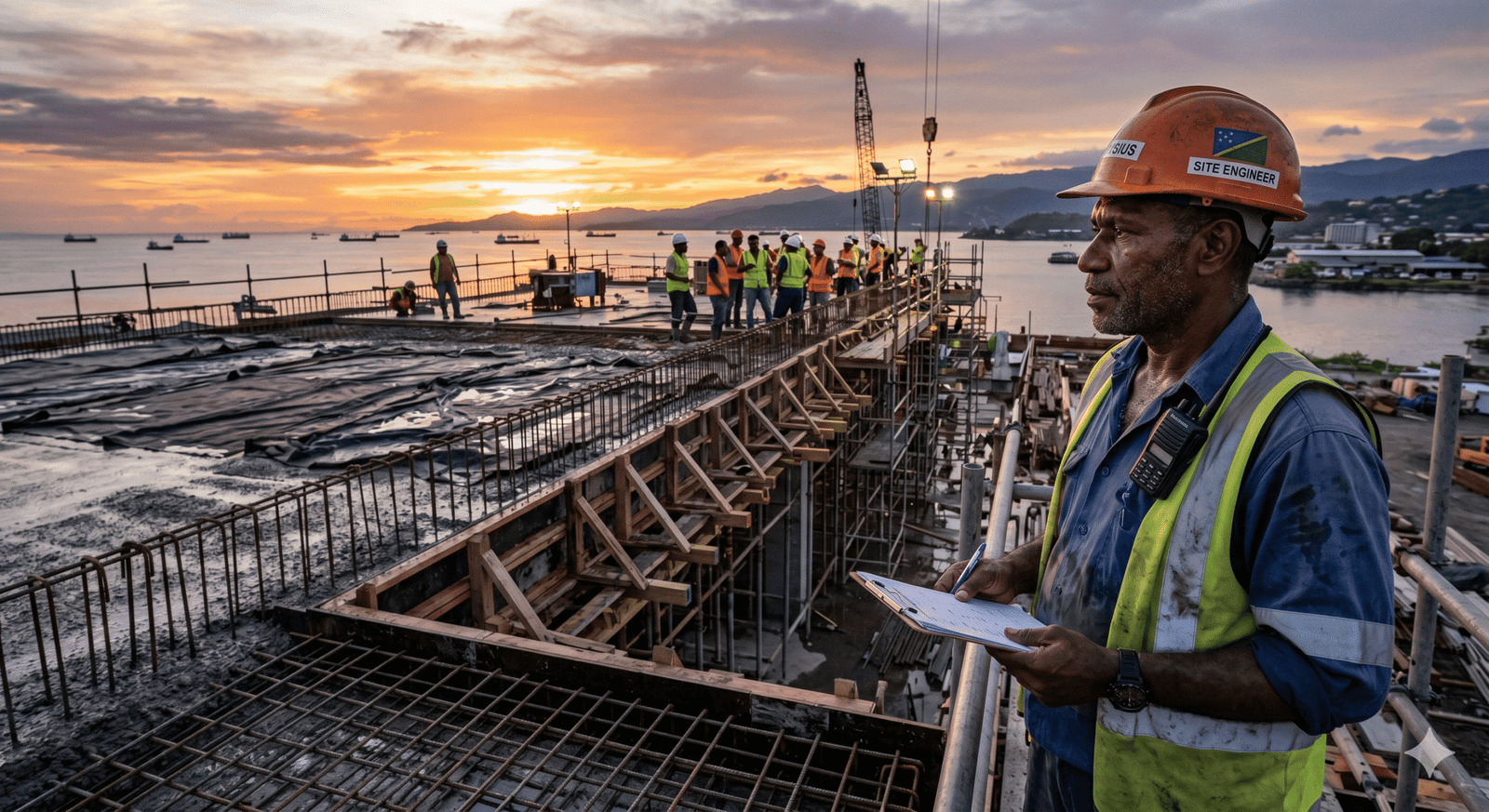
Aloysius* surveys the formwork deck of the new Honiara Port as the sun sets over Iron Bottom Sound. The last concrete pour is curing, the rebar is sweating in the humid air, and the site team are bantering about who is heading to the next big job—whether it’s roads, a port, or a hospital.
In the Pacific right now, that is not mere posturing.
Behind that question is a rapidly growing pipeline of major infrastructure and civil works backed by international heavyweights: the Asian Development Bank (ADB), the World Bank, Australia, New Zealand, the European Union, and China. These mega-projects are large enough to reshape corporate balance sheets, regional supply chains, and quite a few engineering careers along the way.
Under its Pacific Approach 2021–2025, the ADB has focused heavily on connectivity, climate resilience, and essential services across smaller island states. Meanwhile, Papua New Guinea and Fiji continue to scale under their own dedicated country strategies.
For civil contractors, this translates to substantial transport, port, energy, and utility works. Projects like roads, bridges, drainage, and coastal protection are now being packaged at a unprecedented scale.
The operational landscape shifted significantly with the launch of the ADB-World Bank Full Mutual Reliance Framework. This framework allows one bank to take the project lead while the other relies entirely on their internal processes, effectively cutting bureaucratic duplication and speeding up procurement approvals.
The first two landmark projects under this framework highlight the sheer size of this collaborative shift:
Across the wider regional portfolio, the Pacific infrastructure pipeline leans heavily toward climate-resilient engineering. However, the specific asset priorities shift drastically by geography:
If multilateral development banks form the trunk of the financing pipeline, bilateral funders are becoming increasingly influential branches.
Operating through the Australian Infrastructure Financing Facility for the Pacific (AIFFP), Australia is backing critical connectivity and energy projects. This includes subsea cables, power grids, ports, airports, and targeted road upgrades that tie directly to regional trade, climate resilience, and maritime security.
New Zealand’s infrastructure footprint is highly targeted, with a distinct tilt toward aviation safety, maritime connectivity, and resilience-focused community assets. Key opportunities for contractors include airport upgrades, aviation security systems, wharves, and tourism-enabling infrastructure.
Through its regional programming and Global Gateway agenda, the EU is expanding its Pacific footprint via green and digital infrastructure. This means a spike in renewable energy installations, grid modernization, and water connectivity projects.
Contractor Insight: EU-backed initiatives frequently require hybrid packages—civil works tightly integrated with energy, telecoms, and digital control systems, accompanied by stringent compliance and environmental reporting standards.
For construction firms, engineering consultants, and project managers, navigating the modern Pacific market means adapting to three clear trends:
China is no longer an “emerging” player in the region; it is a defining force in the Pacific infrastructure landscape, operating with a distinct commercial model and political logic.
In the Solomon Islands, Beijing’s Belt and Road Initiative has reinforced its dominant role in roads and public facilities. Regional data indicates China’s Pacific aid program is rebounding, utilizing a calibrated mix of flagship infrastructure grants and smaller, embassy-led community projects.
For international contractors, strategic focus should look past the headline numbers. Success lies in understanding how Chinese-backed projects are structured, procured, and delivered, and how they intersect with regional diplomacy and strategic competition.
Back at the Honiara Port, the day-to-day job can still look deceptively familiar: piles, concrete, cranes, and a barge. But in the modern Pacific pipeline, it’s never just a wharf.
Every project sits inside a massive, interconnected system of global trade routes, climate resilience, donor politics, and regional security. The next big move might be a hospital in Suva, a transport corridor in Tonga, or a critical causeway in South Tarawa.
For firms willing to read both the pipeline and the politics, the real work starts well before the first concrete truck backs up to the site.